
Mio Trentino App





Festival dell'Economia Trento - 20 - 24 May 2026
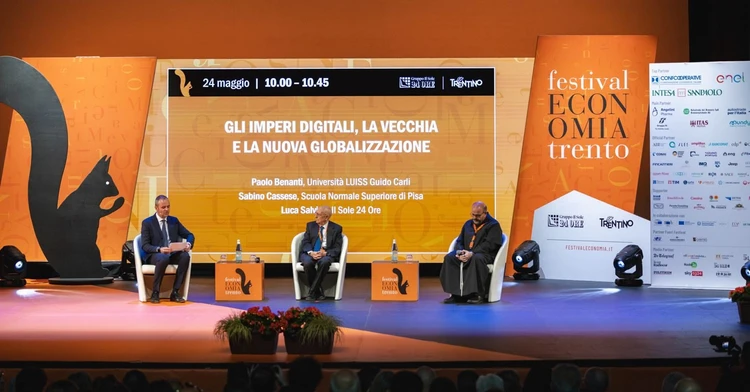
There was a time when the market set the rules. Economists explained that it represented the best possible synthesis not only between supply and demand, but for the entire architecture of the world. Politicians, or at least a good number of them, theorised about its effectiveness. And journalists, or at least most of them, amplified its effects. Once again, things have turned out differently. The market, together with globalisation, has dramatically waned, leaving room for new powers. In some cases, these are truly new, in others, they are the result of major comebacks. Among the new developments is certainly the impetuous growth of big tech, the American multinationals that have built empires in advanced technologies and that now face the ultimate test of artificial intelligence. This is confirmed by comparing the ranking of the largest companies listed on Wall Street. Over the last 20 years, the turnover has been total and resounding: the giants of the old economy have lost positions, from oil groups to telecommunications. Their place has been taken by companies such as Nvidia, Apple, Microsoft, Alphabet, Amazon. These five companies, having grown at an extraordinary speed, now concentrate a total value close to the gross domestic product of the European Union (2024 data), achieving an unprecedented concentration of wealth and power.
Today, big tech unquestionably represents a formidable command centre. Together, they share the keys to unlock developments in artificial intelligence, which are crucial for the future of business and for the lives of all of us. More influential than many states. The latter is a moving front, symbolised by the image of the pendulum swinging, which is now clearly shifting from West to East. The West has to deal with the impetuousness of President Donald Trump, starting with the increasingly frequent attacks on Europe, which in turn has to deal with at least three structural weaknesses: the setback in economic development, the negative trend in demographic indices, and the lack of adequate leadership. On the opposite front, autocracies such as Vladimir Putin's Russia and Xi Jinping's presidency in China are testimony to how democracy has many virtues, but also the flaw of making every choice complex in the decision-making mechanisms and slow in the transition from words to action.
The numbers speak for themselves. Almost 60 per cent of humanity lives in Asia. The largest continent on the planet is home to four of the five most populous countries (India, China, Indonesia, Pakistan) and half of those with more than 100 million inhabitants. India and China, in particular, account for 35 per cent of the world's population, with development rates that are not even comparable to those in Europe. In India’s case, growth stands at around 7-8 percent per year. And despite US tariffs, Asian Development Bank estimates say that by 2026 the Far East will grow by an average of 3.9 percent, with India above 7 percent and China at 4.3 percent. The same applies to the whole of Southeast Asia, with peaks of 6 percent in Vietnam and South Asia. As for Africa, it is set to cross the 2.5 billion mark by 2050, with a median age of under 20: more than 50 different economies that, according to the African Union, can give rise to a single market projected to be worth $3.4 trillion. Today, it is firmly controlled by China, with the rise of players such as Russia, Turkey, India and, above all, the Gulf countries.
All this in the context of an increasingly polarised international competition between the United States and China, with old Europe unable to find its way. Perhaps the most alarming feature is Europe’s trajectory towards a continuous demographic decline, only partially offset by immigration. The birth-rate crisis first emptied the younger age groups and is now eroding the working-age population, while only the elderly population is increasing. According to Eurostat data, Italians over 50 will be the first in Europe to overtake the under 50s, a shift expected to occur within the next five years. This is why we need to move from mere awareness of the demographic winter to active policies to counteract the negative spiral. The best path forward is to give back to young people the hope for the future that many have lost. The primary objective is to bring them back to Italy, countering the brain drain that in 2022-2023 alone led 700,000 of them, as documented by a CNEL study, to leave the country, almost three times as many as those who returned. The need, indeed the necessity, is to create the conditions for Italy and the whole of Europe to become a hospitable land for the new generations, not countries for the elderly. We owe this to our children, and to our grandchildren.


L’ultima ondata...


L’ultima ondata...
L’ultima ondata...